Tuesday, April 14, 2009

Scenes from my 'hood


You know what I don't miss about the DC suburbs? Vinyl siding. None of the houses here have it. Instead, every little house is made of brick, stone, and/or stucco. Their sturdy coziness never gets old as I travel around the neighborhood.


You know what else never gets old? Going to my library for a tote full of books. It's more modern-looking than most buildings near my house, and its insides are eclectic and intriguing. The books aren't the only cool part, the people there are fascinating. There's the tall man with the knit rasta hat who always works the front desk. There are moms with toddlers, people with backpacks napping in chairs, college kids thumbing the DVD cards. And then there are the Orthodox Jewish guys, who fascinate me. They lope along like any guy in his twenties, calling friends on their cells. The only difference is the yarmulkes on their head and the tallis fringe peeking from their fleece jackets. I've always felt like I appreciated my Jewish ancestry, but I've never lived in a town where you can see people walking to synagogue every Saturday afternoon.

I'm not ADD, but my library card is. I always feel like I'll be uncultured or bored if all my books are the same. Here's what I got this time:

Doc In the Box and Accessory to Murder - two of the Elaine Viets mystery novels I am hooked on
The Covenant - a sappy novel in which our Amish heroine battles intrigue. American sects and cults ahoy!
One Hundred Years of Solitude - One of those "books everyone should read" I hear it's about history and memory, which is a bonus
Stalin's Children - Three generations of Russian history. I should also get back in touch with the Eastern European history I used to obsess over.
The Flying Inn - I should also get acquainted with G. K. Chesterton, since he's one of those snarky Catholic authors people always quote.
Oscar Wilde's Short Stories - Once in a while, you need some British witticisms.
Jewish Pirates of the Caribbean - How could I not read this book? The author even lives in Kingston, Jamaica.

Whether I will actually read all of these remains to be seen. I suppose if I really want to be a Renaissance woman, I should pick up some science fiction or math theory. That would definitely be thinking outside my usual box!

Sunday, April 12, 2009

Happy Easter!


The VSC House is so full of Easter candy and cupcakes you might get diabetes walking in the door. There's also leftover ham, potato casserole, and fruit salad. Not to mention my GF chocolate cake with jelly bean Empty Tomb. It's been a fun, relaxing Easter Sunday. Two of the girls had family come into town, so we had quite the full house for brunch. We gave each other "Secret Bunny" baskets of goodies. The Easter Bunny (aka Texas Volunteer) even hid eggs full of jelly beans and confetti poppers around the house. Now we're crashed on the couches, uploading and tagging Facebook pictures of the day.

This has been a lovely, and at times lonely, Triduum. Last year I practically lived in the Catholic Campus Ministry chapel during Holy Week. I always had a crowd of friends around to pray, laugh, sing, and eat with. This year the VSC girls have done some services together, but last night I went to the Vigil Mass alone. I missed my family too, who were all pumped up to see Little Brother #2 serve at "the Mother of All Vigils" (MOAV) back in Virginia.

Two Daughters of Charity were at my Vigil, though, and they insisted on driving me the 50 feet to my house after Mass. It was 10pm after all :-) The Vigil is inherently beautiful - you can't not get goosebumps from blessing sacred fire and hearing the Exultet sung. The ritual can overcome musical ridiculousness, like the tambourine-accompanied musical number the choir director tried to create out of Moses parting the Red Sea. The same guy chose Mozart's Ave Verum Corpus for the communion hymn. I think he is seriously confused.

Mass at the Cathedral this morning, on the other hand, was blissfully magnificent. I was alone again, naturally, but it was worth it. I played in some abridged bell pieces, and just generally enjoyed being part of the choir but not actually having to sing like a professional. Of course the "Christus Vincit" and Hallelujah Chorus nearly reduced me to tears. This Mass was bittersweet, since it might very well be my last playing bells. I hate to leave just when I am finally a good ringer and recognized as part of the group. The "boys club" of lower register bells seems to accept me. Karen, our director, said I am a great ringer. The sacristan even knows I need a low-gluten communion host saved! Dear Pope Benedict, please assign STL an archbishop ASAP so I can play in his installation Mass. Thanks.

Friday, April 10, 2009

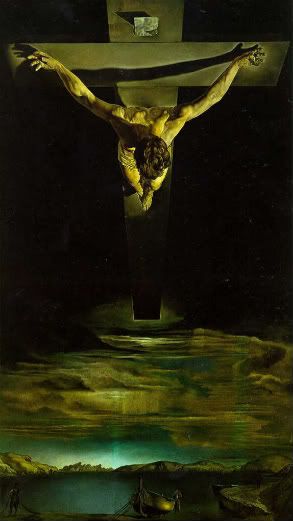
Surely He Has Borne Our Griefs

It's Good Friday, the saddest but most meaningful day of the year. The Triduum of Holy Thursday/Good Friday/Holy Saturday is definitely my favorite time of year as we relive Jesus' last days in real time. I'll be spending a lot of time in church this weekend, attending the most beautiful liturgies of the year. Yesterday I even got to see Bishop Hermann bless holy oils at the Chrism Mass.

Growing up, my family always watched a lot of Bible movies during Lent.
Yesterday's article in Slate about gory, gaudy Passion productions put on by Fundamentalist churches. I had no idea Cirque de Soleil-meets-Salvation History was such a trend right now. The article raises the valid point that the Gospels really aren't the stupendous epics these plays make them out to be. I've seen dozens Jesus movies and none are exactly the riveting "Greatest Story Ever Told" their billing promises. Maybe it's because we know what is coming - some Roman soldiers, some skeptical Pharisees, some preaching to crowds of extras in long robes. It's not quite action-packed. The accounts of Jesus' life are more like ancient tragedies than epics, full of dialogue until the main character meets a rapid and brutal end.

Unfortunately, this article got bogged down in the dialogue. In the process, the author missed the entire point of Easter. He suggested that instead of the Passion, churches should look to
a stirring parable Jesus told about a rich man who sends invitations for a fabulous dinner party, only to have no one accept. So the rich man has his servants round up "the poor and crippled and blind and lame," .... With the fast of Lent over, churches hoping to share their beliefs could take Jesus' parable as a suggestion: Throw a dinner. Make it lavish. "Go out to the highways and the hedges," as the rich man said, and invite the poor, the crippled, the blind, the lame. What kind of story would that tell?
Treating poor people with compassion and dignity - what a concept! It's not like thousands church pantries and religious outreach programs do that every single day of the year. Jesus' death and resurrection are only a disturbing postscript to his career as a "good moral teacher." Let's just give away free stuff and everyone will convert.

St. Paul wrote that "we preach Christ crucified, to Jews a stumbling block and to Gentiles foolishness." It really must seem absurd to non-Christians. They read about this nice man defying religious authority and preaching compassion, so far so good. Then suddenly he's arrested, flogged, tortured, and publicly executed. That is hardly feel-good literature. God willfully choosing for his Son to suffer in a humiliating manner seems illogical. It's not even epic- some obscure person dies in a backwater town.

And yet, it also makes perfect sense. Love one another as I have loved you, Christ commanded. How much did He love? Enough to be arrested, flogged, tortured, and publicly executed for our sake. Enough to quietly endure the same anguish that His creation brought on itself by sin.

Anyone I work with, even the non-religious people, could tell you about the anguish of sin in the world. We see it every day in the lives of our clients. Many of these women have been beaten by boyfriends, ripped off by landlords, enslaved by addiction, raped by men they trusted. They may be guilty of anger of neglect towards their little children. There are oceans of pain in this world caused by selfishness and bad decisions. It takes more than free diapers and or even lavish dinners to change that.

How do you solve such pain? By facing it head on. That's the beauty of the bloody Passion. I'll admit, it used to terrify me. As a child, I hid from crucifixes and the Good Friday scenes in Jesus movies. Then I heard someone describe Christ's death as the most beautiful love song ever written. There is something so comforting, so profound about worshipping a God who endured the spectrum of human misery and pain. For anyone who has ever been backstabbed, abandoned, treated injustly, physically attacked, reduced to the clothes on their back; there is an image in the Gospels of God experiencing the same thing. Through that painful experience, his love purified this sinful world.

He was despised and forsaken of men, A man of sorrows and acquainted with grief; And like one from whom men hide their face He was despised, and we did not esteem Him. But He was pierced through for our transgressions, He was crushed for our iniquities; The chastening for our well-being fell upon Him, And by His scourging we are healed.

Wednesday, April 8, 2009

Beautiful buildings can help you survive political debates

On Monday night Intern #4 and I went to a roundtable discussion about health care reform. The event was hosted by SLU's social work school and Center for Social Justice, so she knew everyone organizing it. I felt like a little bit of an imposter - as I always do when I'm surrounded by people with MSW degrees - until I remembered that my job at a health care non-profit totally makes me legitimate.

The panel was a combination of community organizers, lobbyists, health care advocates, and one health law professor. I walked away feeling like I had learned a lot about different health reform ideas, but I also felt like I needed to read A LOT more about single-payer vs. an "opt-in" government health plan. In the broad political landscape, the US has to decide which is worse - bigger government or a for-profit health system that leaves many people without care. Within the reform movement, there is also a lot of argument about the best way to change the system.

I'm not a hard-line conservative on this issue, but I decided at the meeting that many Single-payer advocates scare me. They are usually intense and determined, fired up with moral indignation. If you challenge their beliefs, then you are an idiot with no compassion for your fellow human beings. Their logic is often simplistic and questionable, too. "Every other country does this; we should too!" "Picture how much you pay for health care now. Under single payer you pay nothing! Woohoo!" They have no patience for gradual change that would accommodate the many Americans who fear "socialized medicine."

Luckily, the meeting was in a building full of lovely architecture. Il Monastero used to be a Presbyterian church. Now SLU has added several meeting spaces and rents it our for events. The longer I stared at the room in front of me, the more I noticed. Check out the picture - see how each chandelier is unique? And the Romanesque arches within the ceiling beams? And the perfect circles near the walls? The accent wall that's a different color from the rest? The only part I didn't like was the abstract-ish artwork. It was a little unnerving to have a female nude smirking at us in her voluptuous fertility. What exactly was the point of that tryptich, anyway? Intern #4 hates the gaudy carpet. I think that's her social worker frugality talking.

Saturday, April 4, 2009

"You're leaving in the morning on an early train" - Phil Collins


I'm really glad I gave up getting rides home for Lent. Taking the bus is teaching me patience and to take things as they come - like when your afternoon train leaves 2 minutes ahead of schedule, pulling away as you try to run to the platform. With all the pockets of waiting time I have, I can read a book, pray the rosary, call my mom. It reminds me of "Jamaica time" on my service trip to Kingston. You get there when you get there, and just have a relaxed attitude as you move through life.

Deciphering the bus schedule and joining the crowds of commuters makes me feel like more of a city-dweller. All week long I have been dying to re-watch Stranger than Fiction, where the bus commute of Will Ferrel's character plays a pivotal role in the plot. I wouldn't mind having Emma Thompson's voice narrate by daily schedule, either.

Stranger than Fiction is not a masterpiece of a movie, but it's a very good one. I'm rather partial to it since it involves many of my favorite things: Emma Thompson, loony professors, ridiculous literary analysis, and Chicago's modern architecture. The soundtrack is pretty good too, and got me interested in the band Spoon. One of their albums got me through my errands today. It was so nice to drive around town with the windows down and peppy rock music coming from the speakers.

Thursday, April 2, 2009

What should we add to the National Mall?

The Smithsonian just released the 6 designs under consideration for the upcoming National Museum of African AmericanLink History and Culture. All of the designs are decidedly modern, echoing the National Museum of the American Indian and East Wing of the National Gallery. This building, slated to open 2015, will likely be one of the last additions to the monuments and museums that already line the National Mall.
I'm excited to see how things turn out, and I hope the museum committee chooses something that will fit the dignity of the location. The slide show of options reminded me of HGTV's Designer's Challenge. Will the homeowners go with tasteful but boring, or ambitious and expensive? Will museum planners want a design that already dictate museum placement? Some architects proposed gallery names or "Door of No Return" slave ship mock-ups.

Here's my humble opinion on the slide show presentations.
  1. Not bad. It wouldn't clash with the surrounding neo-classicism, but it wouldn't quite thrill either.
  2. Ummm, this just looks silly. Like an alien structure from a children's TV show. The huge glass walls are a neat concept, but they don't mesh well with the hulking metal blob.
  3. I like this one. The nautilus design makes a good use of space and nature, and reflects the circular Hirshorn gallery. An ascending spiral of galleries to a "Celebration" view of the monuments gives a good sense of journey. My only qualm is that this lends itself to a strict time line interpretation. Visitors might be reluctant to wander as their interests lead them. I'm also imagining a train of school kids running back down to the bottom once they've reached the end of the line.
  4. Tasteful, with an organic feel, but also a little underwhelming. It's basically a decorated box.
  5. What. The. Heck. Oh, I see, it's "a building made of natural materials, rising as of out of bedrock and muck," aka when Stonehenge imploded next to the Reflecting Pool. "Along one side runs a wetlands scene, a nod to historic Tiber Creek that ran through part of Washington. Its glass roof features etchings echoing Yoruba ancestral arts, and it also has an outdoor amphitheater facing Constitution Avenue." This creative-sounding description is code for "ego as huge as the stone pylons." If this were built, it would be all about the structure, not the exhibits inside it. Every aspect, from the ceiling beams to the outdoor projection screens, is in-your-face and over-the-top.
  6. Ahhh, that's better. Dramatic but not like being pelted with boulders. The wood details are stunning, but I'm not sure how all of this would flow together. You can't just slap a ship's hull onto a rectangle. Also, I'm not sure how I feel about the very literal ship's masts at the entrance. African-American history isn't only about the slave trade.

"Lady Madonna, children at your feet, wonder how you manage to make ends meet." ~ The Beatles

Inadequate nutrition for poor people is always a matter of concern, but it's interesting to see how poverty diets have evolved over time. I'm currently reading Sweetness and Power, in which a anthropologist traces the history of sugar consumption and trade. I skimmed over the complicated mechanics of sugar cane processing, but the social history aspects are pretty cool. How did sugar evolve from the luxury of kings into the obesity-causing bane of school children?

Apparently in the Middle Ages sugar was considered a spice to be liberally sprinkled over meats or mixed into wine. It was also a status-symbol. Sumptuous feasts displayed elaborate sugar figurines or models.
Everything changed with colonization and industrialization. Thanks to the Caribbean, rum and sugar were available in large quantities. At the same time, temperance advocates promoted stimulants tea, coffee, and hot chocolate as alternatives to booze.

Here's where poverty comes in. For a family struggling to put food on the table, hot tea made bread and butter feel more like a meal. It didn't hurt that sugar in the tea provided a few extra calories. I was especially intrigued by the observation that poor Englishmen eventually deserted nutritious oatmeal for bread. Once moms began working in factories outside the home, store-bought bread was a lot easier to serve than all-day-simmering porridge. Jam on bread was also a cheap, tasty, sugary alternative to butter. That's right, fast food was already an issue for busy families in the 1840's. Even then, people were relying on caffeine and sugar to get them through the day.